US Open Trading Tips: BetAngel's exclusive guide to profiting on the Exchange

Sports trader and founder of BetAngel Peter Webb guides us through the best Exchange tactics as the US Open tennis gets underway on Monday...
The perfect betting strategy would have to be profitable, of course. But ideally, you'd want a strategy that offers relatively low losses but with plenty of profit should you win.
But how realistic is it to find a strategy that will enable you to do that? And where do you find it? Well, let me describe one to you.
Backing to Win on the Exchange
If you want to make money betting, you want to bet on something that is going to win. So I'm going to give you a spoiler here, Iga Swiatek won the match that the the first two images below relate to.
So with hindsight, what would you have done? We know Swiatek won, so you would back her to win!
But profitable long-term betting is all about value, and the problem with this bet is that Swiatek was available at incredibly short odds. She was priced at 1.021/50 on the Exchange, which is 1/50 to win this match.
To put this another way, you must put down £50 to win £1. Those odds don't offer the 'plenty of profit' we spoke about above.
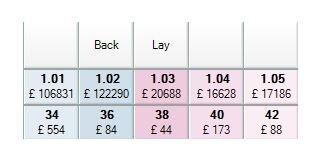
This is often the problem in the early rounds of Tennis tournaments, and will be again at the upcoming US Open, both in the Mens Tournament and the Womens Tournament.
The Gulf in class between opponents means the market will price a title contender at very short odds against a lower-ranked player.
But in this example match, I bet on Swiatek to lose. I placed a lay bet on Swiatek with £3333.33, at odds of 1.031/33. This meant if she lost, I would win over £3000, but if she went on to win, I would lose £100.
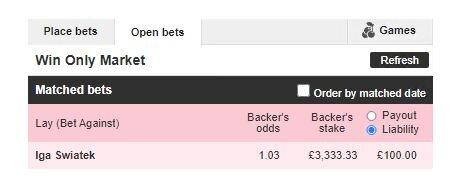
We've already said that, as her prohibitive odds suggested, Swiatek was extremely likely to win. And in fact, she did win this match. But I still made a good profit.
So how was that possible?
Why tennis appeals greatly as a betting sport
One of the great things about tennis is that it can be highly variable; you could be comfortably leading a set having broken serve, but then lose your own serve, and then suddenly, it's a level set again, which leads to some great Betfair trading opportunities.
Suppose we are trading on the Betfair markets, betting on the odds movement that occurs during a match, rather than betting on just the outcome of a match.
That presents us with many opportunities to profit. Regardless of the odds at the start of the match or the end, between those two points, the market will wobble all over the place along the way. And this occurs for several reasons.

Higher-ranked players will be looking to win the tournament. In the early rounds, they don't want to take too many risks, or they could pick up an injury.
Therefore, you often find at significant tournaments that players who are lower ranked will try to win the first set; this is their best chance of creating an upset.
This is especially important when looking at women's matches, where they play the best of three sets.
The essence of trading is not whether the price is efficient at the start or during the match. It's that variability that you see during the match. That is where you will profit if you're trading, rather than betting, on a tennis match.
Lay the winner of a tennis match but still make a profit
In the Swiatek example, at the beginning of the match, we've laid the red-hot favourite with a large amount of money. But because she is a red-hot favourite, our potential loss is minimal.
We're expecting that she will win the match, but she may not have matters all her own way, especially in the first set, giving us our chance to cash out for a profit.
We know when to open this trade before the match starts, but what about exiting the trade?
The great thing about tennis is that if you get a break of serve, you'll see the odds move significantly in favour of the player who has got the break of serve. So typically, you would look for a break of serve during the match as your exit point.
Crucially however, you don't need to get a break of serve; you need the potential for the match to look like there will be a break of serve.
But what should the odds be at that point?
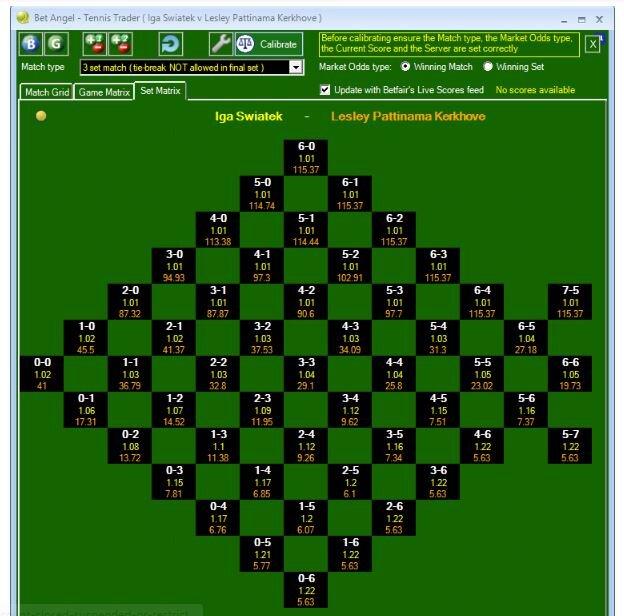
The great thing is I can provide the answer to you because if you are a Bet Angel user, you can fire up Tennis Trader, and then that will tell you what the odds will likely be if a break of serve is likely to occur!
If you start up Tennis Trader before the start of a match, it can tell you where the odds are likely to be given any particular scoreline (see the below image). This will allow you to decide roughly where you would like to either open a trading position or decide to cash out.
How I made a profit on this match
During the match, Swiatek's opponent served first, broke her serve early in the set, and raced into a 4-2 lead. The peak of the Swaitek drift came when she was serving at 2- 4 down and serving at 40-30.
Despite starting as the heavy odds-on favourite, the odds had to change to reflect the chance of Swiatek losing the first set, which was your opportunity to profit.
Because we laid over £3000 for such a small liability, our profit is created by that uncertainty in the market, and we can now cash out of the bet and profit regardless of who goes on to win the match.
A move in the odds from 1.021/50 to 1.152/13 means we net a profit just short of £400 if Swiatek goes on to win. Alternatively we can hedge the bet slightly meaning we make a profit of around £340 regardless of who wins the match.
You should always trade out if you are doing this type of activity because, as happened in this match, Swiatek came back to win. If you'd have kept your position open and not cashed out you would have lost money as your trading position would have just become an outright bet.
How often does this happen?
The remarkable thing is that even when you look at very short odds, like the 1.021/50 in this case, about 70% of the time you will see the price of the heavy odds-on favourite drift during a tennis match. Tennis has that uncertain nature built into it as a sport.
It doesn't necessarily mean that it will get that break of serve. Nonetheless, as the odds move, there is an opportunity to cash out for a profit.
Of course, there are situations where it doesn't occur, and you'll have to take that loss. But typically, the opportunity to profit arises much more frequently than you would expect, given the starting price of a favourite in Tennis.
To Summarise
Regardless of where players' odds start in a tennis match, they can meander fairly significantly throughout a game for several reasons.
Remember, the market has to reflect the chances of a player winning, which directly reflects the score within the underlying match, so the odds must move to correlate with that.
But that presents the opportunity to us from a trading perspective; we're not really bothered about a players' chance of winning a match, we're more interested in the variability and the resulting market changes that we see during the match.
If you actively trade it, then you can profit from it.
We like to go in and lay extremely short odds because the downside is limited. But there is a fair amount of variability that occurs during play, and if you sit on either side of that and pick your entry and exit points correctly, you can profit from it.
***
*To get a FREE trial of Bet Angel and access to it's Tennis Trader tools click here.
GET £50 IN FREE BETS MULTIPLES WHEN YOU SPEND £10 ON THE BETFAIR SPORTSBOOK
New customers only. Bet £10 on the Betfair Sportsbook at odds of min EVS (2.0) and receive £50 in FREE Bet Builders, Accumulators or Multiples to use on any sport. T&Cs apply.
Prices quoted in copy are correct at time of publication but liable to change.