Stick to Cricket: with special guest Jonathan Agnew on his fractured relationship with Stokes post-Ashes
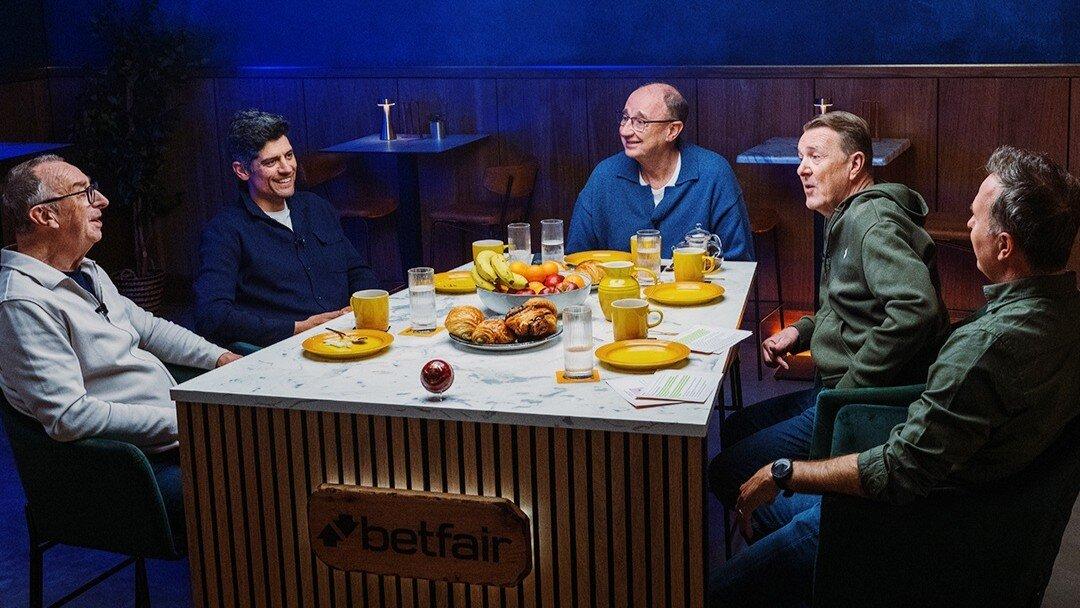
In episode the latest episode of Stick to Cricket Michael Vaughan, Sir Alastair Cook, David Lloyd and Phil Tufnell are joined by English cricket broadcaster and ex-cricketer Jonathan Agnew to discuss why Bazball has been a negative for Harry Brook, and his fractured relationship with Ben Stokes after The Ashes...
- Jonathan questions attitudes towards hard work and preparation in the 25/26 Ashes
- Has Bazball been good for Brook?
- Agnew elaborates on changes during his time in broadcasting
Betfair and The Overlap proudly present "Stick to Cricket," a captivating show featuring renowned England cricket legends Michael Vaughan, Mark Butcher, David 'Bumble' Lloyd, and Phil 'Tuffers' Tufnell.
The weekly show offers insights and discussions, with special guests joining the cricket icons to delve into the sport's hottest topics.
This week the panel is joined by ex-cricketer and leading broadcaster Jonathan Agnew to talk through his career and the demise of England in the 2025/26 Ashes series.
Watch Stick to Cricket episode 39...
Bazball has been a negative for Harry Brook
Jonathan Agnew: "Gus Atkinson is a guy who lost his mother in tragic circumstances, so he knows a bit about that side of life. Jonny Bairstow is in a similar position in the way that he plays the game.
"If you've been through proper tragedy in your life, then sport is sport. But to people who paid a lot of money to go out to Australia, I was angry for them, because it should have been better.
"I felt sorry for some of those players, who sat on that aeroplane going home, who will never go back. That was their one chance, a childhood dream, to go to Australia and win The Ashes.
"They will know that they didn't give it their best shot, for whatever reason. Not being able to go off and play games, or not getting enough cricket, they will know that, for whatever reason, they didn't give it their best shot, and I think that's really sad. The whole question of the culture, I don't know how it got to that.
"What got me about that series was the lack of accountability. If you're going out there and playing poor shots, someone else deserves to have the chance to play and you should be held accountable for not playing responsibly.
"Harry Brook, for me, is a fantastically talented batsman. I just hope he realises it and he fulfils that. For me, his batting in that Ashes... that little reverse sweep at Adelaide... he's a better player than that.
"Is it the environment? It's important to remember that the first 18 months of Bazball were brilliant, a breath of fresh air, entertaining, superb. But it kind of ran away with itself and you're not going to beat the best teams playing like that.
"I just wonder if Bazball has been good for Harry Brook, and some others like Jamie Smith and others, has it been good for them? I don't know. Brook is in that category where I don't think it's been very good for him."
Agnew: Ben Stokes and I had a fractured relationship during The Ashes
Jonathan Agnew: "The relationship, particularly of the BBC correspondent and the England captain, is a precarious one. Because we interview a lot, maybe three times a week, day before the game, at the toss, and immediately after a game. You've got to keep that relationship on a respectful level and if I was to ask the questions where you get shouted at off social media... it's a really difficult balance.
"Ben Stokes and I were very up and down during The Ashes. I tried to talk to him at the airport, and he obviously had something else to do, that was our leaving point.
"There are some great photos of me interviewing Stokes, with his face kind of contorted, staring at you."
Aggers on the attitude towards hard work and preparation for the Ashes
Jonathan Agnew: "I was angry and offended by the attitude towards hard work and preparation from England in The Ashes. Maybe there was a touch of selfishness about it because you wonder if you'll ever get the chance to go back or not. But I really thought England would win this time, if they won the first test, that was my caveat.
"I was offended as well, by the attitude towards hard work and preparation. We're all professional cricketers, with different ways and different styles and different work ethics, but we all know what you have to do to be in the right shape to take the field.
"I found myself likening it to buying a ticket to go to the theatre to watch a play and when you do that, you kind of expect the actors to have learned their lines.
"It just seemed to me; they hadn't done the work. I've got interview examples from Ben Stokes in that Tour, saying 'you don't really understand Jonathan, that was years ago, a long time ago when you used to do those games and it works for us'.
"'Well, you're 3-0 down' doesn't seem to be going terribly well. It was just a stubbornness, because we had been going on about the preparation, and it wasn't in hindsight, in July, when the schedule came out.
"The very first day I remember getting on the radio and being angry. This is not the way you're going to win The Ashes. Australia were there for the taking. If we'd won that first Test, there would have been a fair amount of mayhem in their camp.
"I was just disappointed. Our job isn't hard, in the sense of what a lot of people do for a living, but the hardest part of my job is having to front up and interview the captain straight after a defeat. It's tough.
"It's hard and I really felt for the captain. Ben Stokes at Perth, it wasn't great. Two days, 50,000 people, totally humiliated. And the captain walks off, standing there and you're live. That's a tough interview. It wasn't good that day.
"The England management must take accountability for the poor Ashes series, not the players."
Alastair Cook: "The players did care about The Ashes. The argument saying they don't care is wrong they didn't want to lose in two days. They didn't say 'if I lose in two days, I get two extra days on the p*ss'.
"The management got that wrong, not the players."
Michael Vaughan: "When you have an environment that doesn't have a consequence for failure, you create a culture where it's just too cozy. That's what they've got to change."
Jonathan Agnew: "The problem with the setup was there was nobody to come in and take their place, there was no consequence and a lack of responsibility on and off the field. That's really disappointing. Whoever signed that tour off should be accountable for it."
Agnew on Diversity in cricket broadcasting
Jonathan Agnew: "Technology is the biggest change to my job. When I started doing this, there were no mobile phones or anything like that, so it was just a case of trying to get on the air.
"Tours of India and places like that were tough. The office would be phoning all day just to try and get a line through to the hotel. You'd be sitting in the hotel room all day, looking at a big, black phone, wondering if it would ever actually spark up or not. If it didn't then 'okay, we'll try again tomorrow'.
"I think technology, filling interviews and the way we broadcast now. Those little lines that you literally would wind a handle and you'd hear the call going from Calcutta to Calcutta Exchange, to Bombay, to Tehran, to Berlin.
"You'd hear them all picking them up and plugs going in, then someone would finally say 'London!'. That would be the Post Office tower, plugs would go in and you'd miraculously go through to Broadcasting House. That was how it was, now you just dial up a number and on you go.
"The biggest change since, if you look at when Bumble and I were doing it, was that it was entirely white, entirely male and entirely 50-year-old middle class people. In terms of the program (TMS) the biggest change has been the diversity.
"That's a good thing. Cricket is for everybody and the way that the programme has evolved from that perspective has been a triumph."
Read Ed Hawkins' latest IPL and PSL Tips here
GET £50 IN FREE BETS MULTIPLES WHEN YOU SPEND £10 ON THE BETFAIR SPORTSBOOK
New customers only. Bet £10 on the Betfair Sportsbook at odds of min EVS (2.0) and receive £50 in FREE Bet Builders, Accumulators or Multiples to use on any sport. T&Cs apply.

Prices quoted in copy are correct at time of publication but liable to change.