What is Baccarat? Origins and rules of the classic card game

Baccarat is a classic card game with a rich history, simple rules and intriguing odds. Discover its origins, gameplay, payouts, and tips for playing online in this comprehensive guide.
-
Fast-paced casino card game does not require skill or strategy
-
From 960 BCE the game has been transformed by cultures
History of Baccarat
Many familiar casino card games, including blackjack and poker, have a long and sometimes mysterious origin story.
This is true for baccarat which may have been created from games played in China and Europe almost 3,000 years ago.
Baccarat Origin - China
In 2010, a University of Nevada research paper titled 'History of Baccarat', shed light on the mysterious backstory of this popular card game. It suggested that the card game may have developed from the Chinese game Pai Gow, a version of which is still played at casinos.
Pai Gow means "pay nine", which is the best score in baccarat, and while the game was played using dominoes, not cards, the rules and gameplay are quite similar.
Baccarat Origin - Italy
The research paper also suggested that Pai Gow may have travelled to Europe as a result of Marco Polo's infamous voyages to the Orient. By the 15th-century, a game called Baccara first appeared in the region. Baccara was invented by Felix Falguierein, an Italian croupier and tarot card reader.
Meaning "zero", baccara featured the familiar baccarat rule that all face cards and tens had a null value.
Baccarat Origin - France
By the 19th-century, baccara became one of King Charles VIII's favourite games and the monarch introduced it to French nobility and aristocracy. The game became known as Chemin de Fer and was played amongst up to 12 players.
The objective of Chemin de Fer is to get to a total as close to or equal to nine points using two, or sometimes three cards.
Baccarat Origin - USA
Following its success in France, Chemin de Fer first travelled to England where it was exported across the globe, including the US. The first official instance of this game in the country dates back to 1871 when a New York Times article referred to a baccarat board.
While baccarat and many other forms of gambling were illegal across the US for the majority of the 20th-century, they became legal in Nevada in the 1950s. It was probably Francis "Tommy" Renzoni who introduced the familiar game to land-based casinos after bringing it from Cuba.
How to Play Land-Based Casino Baccarat
Today, you will find two main types of baccarat games played at casinos. Land-based casinos feature a game where players can bet on whether the player or the banker will get the highest number of points up to a maximum of nine. A tie bet is also available.
In a counter-clockwise order, cards are passed from one player to the next. The player holding the box, or shoe, is the banker. Four cards are dealt and initially placed facing down. The player whose bet was the highest on the player's hand gets two cards, whereas the other two cards go to the banker.
When the player who got the cards has looked at them, they are passed to the dealer and their total point value is declared. The same is done with the banker's cards and the hand that has the highest point value is declared the winner.
Playing Baccarat Online
Many online casinos, including Betfair, feature games that have adapted the land-based gameplay to be more user-friendly and practical. For example, in most games, no matter whether you are playing RNG or live dealer baccarat, cards are dealt directly to the player and the banker boxes without first being given to any player.
Online baccarat gameplay is similar to that of online slots and does not require any skill. You simply need to guess which side will be the winner or if the game will end in a tie. There is no way of knowing for certain and there is nothing that you can do to influence the result.
While there are numerous strategy and betting guides on poker, blackjack, and other games, baccarat is a game of chance which is much less reliant on any strategic decision-making.
Baccarat Odds and Payouts
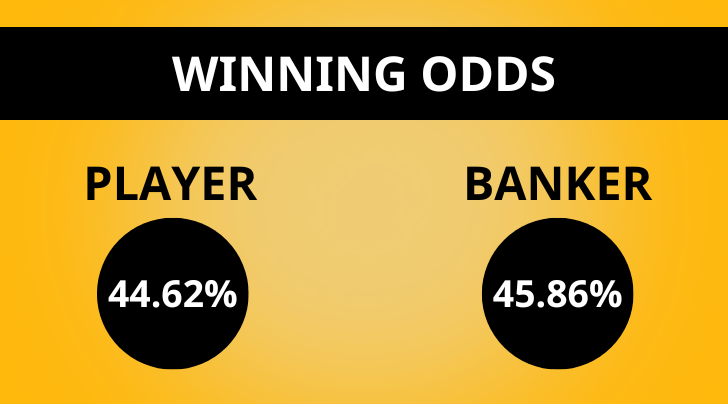
In most versions of the game, the banker has winning odds of 45.86%, while the odds of the player winning are 44.62%. This difference is due to the rules governing the third card. Moreover, while the banker has a slight advantage, most games charge a 5% commission on winning banker bets.
As a result of this charge, winning banker bets pay out 0.95:1 whereas winning player bets pay out 1:1. Tie bets pay out between 8:1 and 9:1. However, the odds of winning this bet are 9.52%.
The house edge on a banker bet in baccarat is 1.06%. This is significantly lower than the house edge on many of the best RTP slots which normally have a house edge hovering around 3.5%.
Top Tips for Playing Baccarat Online
Even though you don't need to develop a strategy to play baccarat, you should keep the following tips in mind:
- Bet on the banker - With odds of 1.06%, the banker bet is the most strategically safe baccarat bet.
- Stay away from the tie bet - While its payouts may be alluring, the tie bet's odds are poor, and while it might make for an interesting bet, you shouldn't place it regularly.
- Take advantage of casino bonuses - Check the latest casino offers and promotions for baccarat-friendly rewards that could boost your bankroll.
Key Takeaways
- The history of baccarat is almost three thousand years long with influences from various Asian and European cultures.
- Assigning zero to face and ten cards has been done since the 15th-century croupier, Felix Falguierein, invented Baccara.
- While there are different versions of casino baccarat games, they are all based on luck and don't require any playing skills.
- If you're ever unsure which bet to place, you should bet on the banker since it has the best odds in the game.
- You should always play baccarat and all other casino games responsibly and never gamble more than you afford to lose.
Prices quoted in copy are correct at time of publication but liable to change.