Roulette Through the Ages: History and evolution

Roulette's journey spans centuries, from its European origins to its American evolution and online presence. Explore its rich history and key differences throughout the ages.
-
The roulette wheel history spans almost 400 years
-
One of the top casino games in Europe, the US and around the world
The Start of the History of the Roulette Game
The exact origins of the game that we call roulette are shrouded in mystery. It is widely believed to have been created by the renowned French mathematician and philosopher, Blaise Pascal, in the 17th-century.
However, creating an entertaining gambling game was not his objective as his efforts were dedicated towards developing the world's first perpetual motion machine. This is a hypothetical machine that defies gravity and works without fuel or external influence.
Following his invention, the game began to take shape, but it took a few hundred years for it to be called Roulette, or "little wheel".
French Influence on Roulette History
Early versions of the game began in French salons in the 18th-century. Both single and double zero pockets were present, the latter preferred by operators who benefitted from the higher house edge.
By the 19th-century, François and Louis Blanc modified the game and made it available to commercial establishments. Players preferred the single zero version so the double zero pocket game was set aside.
The History of Roulette in Europe
Throughout the 1800s, roulette spread across Europe and was a popular game at lavish casinos in Monte Carlo, London and Berlin. The game became synonymous with glamour and sophistication, a reputation that's maintained to this day.
Similarly to baccarat, roulette was popularised by the aristocracy and socialites, becoming one of the main gambling games on the continent. Its popularity soared even further as it began appearing in literature, where it was portrayed as a symbol of risk and fortune.
Not everyone was enjoying this wheel game, however, as members of the clergy declared it the Devil's Game. The reason behind this nickname is the fact that if you were to add up all the numbers on the wheel, the total would be 666, a number typically associated with the ruler of hell.
Roulette Spin History in America
By the mid-1800s, roulette had crossed the Atlantic Ocean. American casino operators re-introduced the double zero pocket and thus created a distinguishing feature between American Roulette and European or French Roulette.
Despite the higher house edge, the game kept its allure and became common in the fledgling gambling industry. Unlike in Europe, it was the workers who accounted for the majority of roulette players.
Roulette History in an Online World
With the introduction and rise of the Internet in the late 20th-century, roulette and other popular casino games, including slots, transitioned online. Online casinos were now able to offer their games to a significantly larger audience and provide a full suite of games and variants which included both American and European Roulette.
Roulette today
Modern-day roulette remains one of the most popular casino games in the world, including at Betfair Casino. Online platforms and software providers have expanded the features of this game to include bonus multipliers, fast-paced gameplay, or optional side bets.
The game's enduring appeal lies in its simplicity and unpredictability. Players have the chance to play according to their risk profile, choosing between riskier, high-payout straight-up bets or less risky, even payout outside group bets.
Classic roulette games today have a favourable house edge which, in the case of French Roulette, can be as low as 1.35%. This is lower than most other table games and even many of the best RTP slots.
Future of Roulette
While it's impossible to predict the future, roulette will most likely retain its position as one of the leading casino table games in the world. As technology continues to develop, the game will likely undergo further innovation.
Virtual Reality (VR) and Augmented Reality (AR) technologies, for example, are already being used in casino settings and offer unparalleled realism through immersive experiences.
Key Differences in Roulette Wheel Games
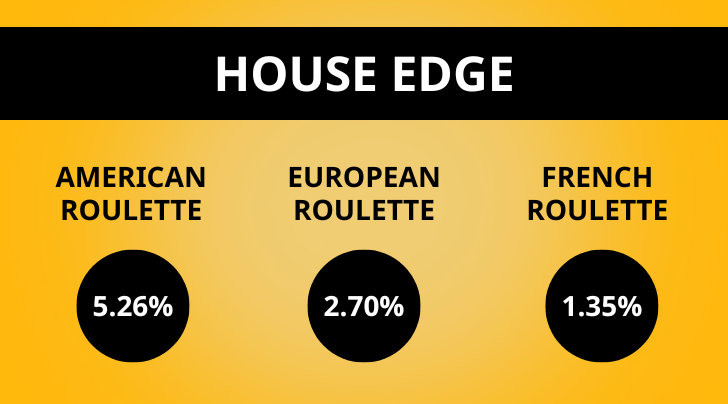
Through four centuries, the roulette wheel developed into several versions. European and American versions are the most popular, but a French version is also available. Playing this game is fairly straightforward and you can read more about the best numbers to play and understand the odds of the game in separate betting guides we've written.
The easiest way to identify an American Roulette table is to look at the wheel. This version has two green segments on the wheel, a zero and a double zero. Due to this additional number, the house's edge is 5.26%.
Both European and French Roulette wheels have a green zero, but the French table would normally include markings for "La Partage" and "En Prison". These are special conditions that apply when the ball lands on zero.
Key Takeaways
- The history of roulette likely started in France in the 17th-century. Blaise Pascal is attributed with its invention, though his objective was to create the world's first perpetual motion machine.
- From France, roulette travelled across Europe and eventually landed in America. There, the so-called American Roulette game was born, adopting the two green pocket wheel design that proved unpopular in Europe.
- Roulette was one of the first casino games to transition online. Today, it remains one of the most popular games around the world.
- American Roulette has a house edge of 5.26%. European Roulette's house edge is 2.70%, whilst in French Roulette, the house edge is 1.35%.
- No roulette strategy or bets can guarantee a prize, and even though the game has a relatively low house edge you should always gamble responsibly.
Prices quoted in copy are correct at time of publication but liable to change.