Poker Chip Values: The essential guide for players

Understand why poker chip values matter, how colors represent different amounts and how to identify chip values for a smooth and organized experience...
-
Understand poker chip values and how to use them
-
Place the right chips at the right time
-
Improve your strategy with our essential guide
Why Poker Chip Values Matter
In every poker game, chips act as currency and players use them to bet, raise, or call. Each chip represents a certain value which corresponds to the amount of money at stake.
For seasoned players, recognising poker chip values by colour is second nature, but for beginners, the myriad of colours can be confusing.
By learning the official chip values in poker, you can improve your speed of play and understanding of the stakes.
What are Poker Chip Colour Values?
Poker chips have different colours to be easily recognisable and to avoid mixing one stake for another. Although there can be some regional variations, most operators, including Betfair Casino, adhere to a set of standard poker chip values.
|
Chip Colour |
Chip Value |
|
White |
These are typically the lowest denomination, often worth £1 or equivalent |
|
Red |
Usually represents £5 |
|
Orange |
These chips typically have a value of £10 |
|
Yellow |
Commonly set at £20 |
|
Green |
Commonly set at £25 |
|
Black |
Represent higher denominations, such as £100 |
|
Purple |
Sometimes valued at £500 |
|
Maroon |
Typically represent the highest denomination, such as £1,000 |
By being familiar with the official poker chip values above, it'll be easier for you to follow betting rounds and understand the current stakes. Nevertheless, when you're playing online, the chip value is often clearly shown beside or on the chips.
Poker Chip Values in the UK - A Closer Look
In the UK, poker chip values by colour may vary slightly from other regions, such as Las Vegas, but they generally follow the familiar pattern. However, establishments may also use multi-coloured chips or rectangular plaques, though these are often limited to poker tournaments or high-stakes cash games.
Moreover, if you're playing at home or in an informal poker room, the chips' colours and corresponding values may vary for convenience or to match the game's structure. In such instances, it's a good idea to define the chip denominations beforehand.
Providing all participants with a reference guide to the poker chip colour values ensures everyone understands the stakes and avoids confusion.
How to Identify Poker Chip Values
If you're new to poker, identifying chips by their colour is a skill worth mastering. Once you're familiar with colour poker chip values, you'll be able to focus on gameplay and strategy rather than trying to figure out how much each bet is.
Below are some useful tips to help you recognise chips easily. If you're interested in learning more about poker strategy, you'll find several articles in our casino betting guides.
- Look at the colour - Each colour represents a specific denomination. For example, white chips often have the lowest value, and purple or maroon chips tend to have the highest value. By knowing the basic colours you'll avoid betting the wrong amount.
- Check for markings - In many formal settings, chips are marked with their value. This makes it easier to distinguish between them. However, in poker home games, this might not be the case.
- Ask for clarification - If you are unsure of the chip values in a game, don't hesitate to ask. It's better to clarify early than to misjudge the stakes during a hand.
Setting Up a Poker Game with the Right Chip Values
Having a clear structure for the poker chip values by colour is important. To ensure a smooth game, you'll want enough chips for all players and a good balance between lower and higher denominations.
For a typical low-stakes game of between six and eight players, you'll need:
- 80 white chips (worth 50p or £1 each)
- 32 red chips (worth £1 or £5 each)
- Eight orange or yellow chips (worth £5 or £10 each)
This setup provides enough chips for standard betting rounds while allowing for flexibility in rebuys or changes in the small and big blinds.
Adjusting Poker Chip Values UK for Tournament Play
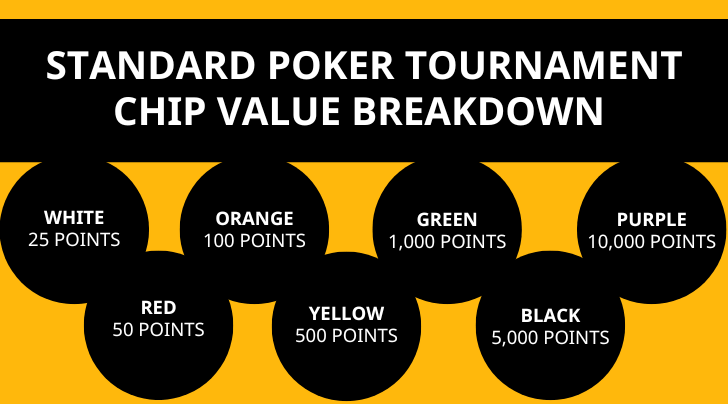
Tournaments typically require a different poker chip value setup compared to cash games. In these competitions, chips represent points rather than money and the value structure normally escalates as blinds increase.
It's crucial that you understand this mechanism since betting strategies in poker tournaments differ from those used in cash games. Unlike other casino games, such as online slots, having a strategy in place, even a basic one, can improve overall performance significantly.
It's also worth noting that, unlike most casino games, regular poker games are not subject to a house edge. As a result, using an effective strategy that includes bluffing and aggressive raises can lead to games with higher payout percentages than some of the best RTP slots.
A standard poker tournament chip value breakdown might look like this:
- White Chips - 25 points
- Red Chips - 50 points
- Orange Chips - 100 points
- Yellow Chips - 500 points
- Green Chips - 1,000 points
- Black Chips - 5,000 points
- Purple Chips - 10,000 points
This structure allows a clear progression of blinds without running out of lower denomination chips.
Key Takeaways
- While poker chip colour values vary by country and sometimes by establishment, white and red are normally associated with the lowest-value denominations. Black, purple, and maroon, meanwhile, represent higher-value denominations.
- During poker tournaments, poker chip values are sometimes converted into points, but the structure remains the same, with white chips having fewer points than black or purple.
- Understanding official poker chip values can help you focus your attention on a winning strategy.
- Since poker chip values in the UK may vary from those in Las Vegas and other US casinos, it's always best to check them before you start playing. It's also worth checking specific values during home games.
- Responsible gambling should be a part of your strategy, even if you're gambling at home or in an informal setting. Only buy chips that you can afford to lose and never chase your losses as you're likely to increase them.
Prices quoted in copy are correct at time of publication but liable to change.