The States of Online Gambling in the U.S.
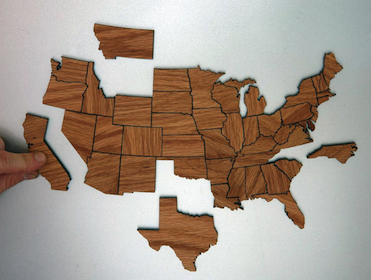
Speaking with PokerFuse last week, Rich Muny of the Poker Players Alliance reiterated the PPA’s backing of federal legislation, noting how the absence of such will necessarily lead to “a quilt-work of 50 state laws” that may prove especially arduous to enforce.
The crossing of the one-year anniversary of Black Friday last week refocused attention on the still highly complicated legal landscape for online poker in the United States. While some continue to petition for the passage of some form of federal legislation to license and regulate online poker the U.S., most observers believe it more likely we'll see individual states try to offer such games first, with the possibility of multi-state "compacts" forming at some future date.
An apparent change of position by the U.S. Department of Justice regarding the half-century old Federal Wire Act has spurred a lot of legislative activity on the state level with regard to online gambling, with many states seeing the DOJ's new view as a possible invitation to pursue a new source of revenue via online gambling. Indeed, gambling law professor I. Nelson Rose has described the memo as "a present from the DOJ" to those with an interest in being able to gamble online, as well as to state legislators with an interest in passing laws to enable such.
It was in late December of last year that a memorandum written by Assistant Attorney General Virginia A. Seitz back in September regarding the Wire Act became public. In that memo, Seitz responded to a question regarding whether two states (New York and Illinois) could sell state lottery tickets online. In her response, Seitz noted that the Wire Act "prohibits only the transmission of communications related to bets or wagers on sporting events or contests," and thus did not prohibit the selling of lottery tickets over the internet.
In fact, late last month Illinois began selling lottery tickets online during the recent Mega Millions hysteria. Meanwhile, several states have begun to explore the possibility of offering online gambling -- including online poker -- within their states, with most eyeing the possibility of accepting players from other states in much the same way multi-state lotteries currently operate.
Speaking with PokerFuse last week, Rich Muny of the Poker Players Alliance reiterated the PPA's backing of federal legislation, noting how the absence of such will necessarily lead to "a quilt-work of 50 state laws" that may prove especially arduous to enforce.
Indeed, the situation has already become quite complicated to follow. Here is a survey of what several states have been up to over recent months with regard to online gambling legislation and the various states at which such efforts presently stand.
California
Along with Nevada, New Jersey, and now Florida, California is a focal point for brick-and-mortar poker in the United States. Like some other states, California has been considering the possibility of offering legal intrastate online gambling for some time, though has yet to do so.
Last year two different bills were proposed, dividing supporters of online gambling and further complicating an already dense web of political and tribal interest and influence, and neither passed. This year a new bill is being considered, one which purports to offer online poker only for two years, then other games afterwards. The new bill also specifically restricts its games as intrastate only -- that is, unlike other states' bills, California wouldn't be entering into multi-state "compacts" or offer games to international players.
Connecticut
A week after the DOJ's letter was made public, the governor of Connecticut, Dannel P. Malloy, indicated his interest in pursuing intrastate online gambling as a source of revenue for his state. Legislators have since discussed the possibility, including the state's two prominent Indian tribes (the Mashantucket Pequot and Mohegan tribes) in the discussions.
However some Connecticut legislators, including Senate Minority Leader John McKinney, are steadfastly opposed to online gambling, thus decreasing the likelihood any bills will be seriously considered there in the near future.
Delaware
Late last month Delaware governor Jack Markell announced the offer of a deal between the state and Delaware's three casinos regarding possible licenses to offer online gambling within the state. The deal involves lowering licensing fees in exchange for the state getting a cut of gambling revenue.
The plan would involve offering casino-style games (including poker), the lottery and Keno games, as well as some forms of sports betting (e.g., parlay betting on NFL games). No legislation has been proposed as yet, and Markell's plan has both supporters and detractors at this early stage.
District of Columbia
For a couple of weeks late last summer, it appeared D.C. was poised to beat all 50 states and offer online poker within the federal district as part of its lottery program. Having passed legislation to do so, plans were in place to begin offering such games in September, though controversies surrounding both the legislative process and the awarding of the contract to run the new games forced a delay, not to mention a lot of bad publicity.
After further investigation and discussion, the D.C. Council voted in early February to repeal the previously-passed online gambling law, thus ending the prospects for such in D.C.
Hawaii
Most were surprised back in January to hear that legislators in Hawaii -- traditionally opposed to gambling in all forms -- had proposed an online gambling bill of its own. The bill was proposed along with an earlier one to create the state's first lottery. A third bill to legalize casino gambling had been pushed forward as well.
However, by mid-March two Hawaii congressmen, Angus McKelvey and Joseph Souki, informed observers that all three bills had failed to drum up enough support among legislators and had been set aside.
Iowa
Ahead of the curve somewhat, Iowa was already looking into the possibility of online gambling last spring, and in fact the state's legislators were working on a bill even before Black Friday. A watered-down version of the bill was eventually passed by both the state's House and Senate and signed into law by governor Terry Branstad in late May 2011 -- not to license and regulate online gambling, but rather for the Iowa Racing and Gaming Commission to study it before any licensing and regulation could take place.
As that study was being completed, the DOJ's reinterpretation of the Wire Act was made known, and early this year a new online poker-only bill was proposed with the Senate voting in favor of it in March. However, that quickly ran out of steam in the Republican-led House, and was soon declared dead for 2012.
Mississippi
A bill to regulate online gambling in Mississippi was proposed by a member of the state's House in February, but within just a few weeks failed to make it out of the House Ways and Means Committee.
Nevada
Like Iowa and New Jersey, Nevada has been well out in front of other states in its consideration of online gambling, having already been discussing a bill last spring, and passing legislation in June 2011 to establish regulations for the issuing of licenses and the operation of online gambling businesses once a federal law was passed or the DOJ indicated states would be allowed to set up online gambling themselves.
Thus was Nevada especially prepared once the DOJ's letter became public in late December 2011. In fact -- coincidentally or not -- the state had only a day before finally approved regulations to begin issuing licenses to operate online gambling businesses in Nevada. By now a number of companies have already applied for licenses, and last month Mark Lipparelli who chairs the Nevada Gaming Control Board announced he believed intrastate online poker could be up and running in Nevada by the end of 2012 or early 2013.
New Jersey
In New Jersey the state's legislature had in fact passed a bill to legalize online gambling last spring (prior to Black Friday), but the state's governor Chris Christie vetoed it in March, with many believing the DOJ's apparent opposition to online gambling had encouraged him to do so. However, as we have seen in other states, the DOJ's revised opinion ignited interest in such a bill once again, and in early January another online gambling bill was proposed by senator Raymond Lesniak.
That bill currently has gathered some momentum although the process has been slowed by the legislative calendar. A committee of the state's senate has passed the bill (unanimously), and the full senate will vote on it at the end of May. The bill will specifically allow the state to accept bets from players in other states and countries, as long as doing so doesn't violate any other state or federal laws. Indications are that Governor Christie will likely support the new bill thanks to the DOJ's new stance on the Wire Act.
Utah
Going against the grain, the state of Utah has not only resisted pursuing the possibility of intrastate online gambling, the state has passed legislation clarifying its illegality. In March, Utah governor Gary Herbert signed a bill into law prohibiting online gambling in his state. (Utah has long been known as one of only two states in the U.S. -- with Hawaii -- essentially prohibiting gambling in all forms.)
The bill, which goes into effect on July 1 of this year, further stipulates that Utah will opt out of any federal online-gambling legislation, an option most believe will necessarily be part of any nationwide bill. Herbert has also been lobbying U.S. House and Senate leaders not to support any federal online gambling bills.
Prices quoted in copy are correct at time of publication but liable to change.