From Medals to Chips: Poker and the Olympics
Every Olympics we read stories about the athletes passing time in the Olympic village playing poker. Of course, in some cases the athletes continue to play poker even after the Olympics have ended.
The 2012 London Olympics are well underway, filling the gap for a lot of us during what is a relatively quiet period, poker-wise. The Olympics, of course, provide all sorts of opportunities to contemplate the meaning of competition and how -- like happens in poker -- skill and luck often combine to affect outcomes.
Many have noted connections between poker and the Olympics. At the culmination of his 1990 classic Big Deal: One Year As a Professional Poker Player, Anthony Holden alluded to Olympians' training and the momentous occasion of their competing when describing his return trip to play in the 1989 World Series of Poker Main Event.
"In no way had I expected the sense of foreboding that now overwhelmed me," writes Holden, thinking back to how the story had begun a year before at the 1988 WSOP and the year-long odyssey of playing and study that had intervened. "Suddenly I knew what it must feel like to be an Olympic athlete, or a golf or tennis pro, arriving at the venue appointed for the year's main event, burbling about a rendezvous with destiny."
Every Olympics we read stories about the athletes passing time in the Olympic village playing poker. Brett Collson of PokerNews provided a recent example earlier this week, reporting on several Olympians enjoying a game of cards when they are not competing. Of course, in some cases the athletes continue to play poker even after the Olympics have ended.
We've known for quite some time that the U.S. swimmer Michael Phelps has a fondness for poker and has several friends within the poker community. Indeed, following his earning an all-time Olympic record 19th medal earlier this week, there were some well-known poker pros among the many to whom Phelps tweeted thanks for their congratulatory messages.
We first learned Phelps was a poker player a few years ago. Just a couple of months after his stunning performance at the 2008 Beijing Olympics where he won a record eight gold medals, Phelps made a splash (pun intended) in the poker world when he final tabled a $1,500 buy-in event at the Caesars Palace Classic.
The tournament drew 187 entrants, and Phelps made it all of the way to ninth before being eliminated on the second day of the two-day event. The poker room manager at Caesars cheekily gave Phelps a ninth-place gold medal for his finish to go along with the $5,213 prize.
There have been a few other Olympic athletes among the celebrities showing up to play the World Series of Poker Main Event of late.
The Swedish cross-country skier Marcus Hellner played in the 2010 WSOP Main Event. Earlier that year Hellner had won two gold medals at the winter games in Vancouver in the 30 km pursuit and 4x10 km relay.
Another Olympian from Scandinavia, Petter Northug, has played in the Main Event the last several years, in fact. Also an elite cross-country skier -- a rival and friend of Hellner -- Northug won four medals at the 2010 Vancouver games, including two golds in the 50 km classical and team sprint events.
Northug actually made the money in the Main Event in 2010, finishing 653rd for a cash of $21,327.
British boxer Audley Harrison is another Olympic champ who likes going for knockouts in poker tournaments, too. Harrison won gold at the 2000 games in Sydney in the Super Heavyweight division, a highlight of a stellar career.
Harrison has been playing poker for several years, turning up at tournaments frequently in Las Vegas and California. He often plays at the WSOP, and was there participating in a few events this summer. "A-Force" has a couple of WSOP cashes to his credit, and in 2010 took third in a $2,000 deep-stack event at the Venetian that drew over 500 entrants, earning a $90,298 payday.
Another boxer, Jeff Fenech who represented his home country of Australia at the 1984 Olympics in Los Angeles, has played some poker during recent years. I remember him playing in the 2010 WSOP Main Event at the feature table against Johnny Chan. Fenech would be back again the following year to play the Main Event, too.
Olympic champion Fatima de Moreira de Melo, is also a regular participant at the WSOP. The Dutch field hockey player won medals with her Netherlands team on three separate occasions -- bronze in 2000 (Sydney), silver in 2004 (Athens), and gold in 2008 (Beijing). She has numerous cashes to her credit, including four at the WSOP and several on various European tours.
Perhaps the most accomplished tournament poker player with an Olympic background is Donnacha O'Dea who swam for Ireland in the 1968 Summer Olympics.
While O'Dea won no medals that year in Mexico City, he did win gold at the WSOP when he took the bracelet in a pot-limit Omaha event in 1998. He also made the final table of the WSOP Main Event in 1983, finishing sixth. Incredibly his son, Eoghan O'Dea, would replicate his father's feat 28 years later with a sixth-place finish in the 2011 WSOP Main Event.
Donnacha has earned over $1.2 million in tournaments worldwide during a lengthy poker career extending back three decades. At the WSOP he's made 26 cashes and reached eight final tables during that span, including a fifth-place finish in Event #37, the $2,500 eight-game mix event, at this summer's Series.
 No wonder Holden -- who also writes about playing with O'Dea in Big Deal -- chose the experience of training for and competing in the Olympics as a suitable analogy when describing his return trip to the WSOP.
Of course, it could be the comparison occurred to Holden because his grandfather, Ivan Sharpe, was an Olympic champion! Sharpe won a gold medal way back in 1912 in Sweden along with the rest of the Great Britain football squad after they defeated Denmark in the final 4-2.
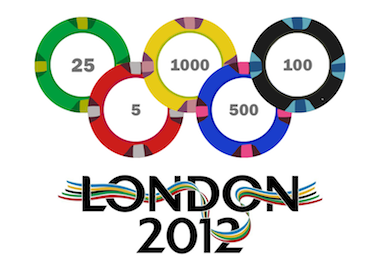
Thanks to John Wray for the illustration up top. Wray and Jay Rosenkrantz are the co-creators of The Micros -- see their videos on YouTube and follow them on Facebook.
Prices quoted in copy are correct at time of publication but liable to change.