Click here to download a free trial of Bet Angel today!
Punting on politics may not sound interesting, but it's one of the most fascinating and fastest growing markets on the Betfair exchange.
My interest in political markets was first aroused in 2004 when John Kerry and George Bush went head to head in the presidential race. I went to bed that night believing that John Kerry would be the next US president, only to wake up in the morning with Bush duly re-elected. £17m was matched on the market and John Kerry had plenty matched as low as 1.251/4. Politics had become interesting. My interest in these markets were rising and so was the matched bet turnover.
These markets typically follow the election cycle and peak and trough in alternate years. As time has progressed though, political markets have become more regular and a mainstream betting market. This is probably for their broad predictive nature and the ability to make a news story!
Some blogs now specialise in political betting. As the broad interest in these markets has risen, it's not just the big markets that have grown, but also the side markets. When Jeremy Corbyn was put forward as the next Labour leader, the market offered him in the 300's and he won. On the flip-side other candidates saw low prices and lost. Andy Burnham traded at 1.845/6 and Yvette Cooper at 2.506/4 had their hopes of leading the Labour party extinguished by a raft of new members voting for Corbyn.
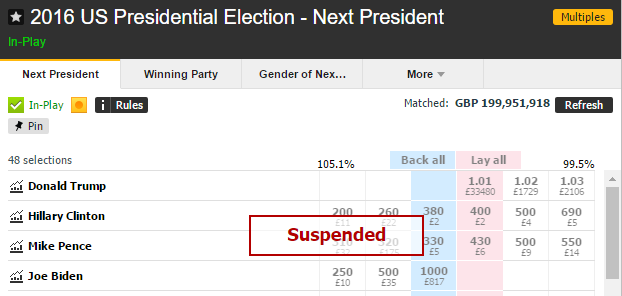
Another notable election was the Scottish Referendum which topped £14m, but this was totally eclipsed by the EU Referendum which saw matched bets of just short of £114m and another short-priced loser. Remain was matched for good money at just 1.061/18. Laying at 1.061/18 means you are risking just £60 for a £1000 reward if you pick a winner. That however was, appropiately, trumped by the US Presidential market which matched just short of £200m.
Always in-play
There is no specific delineation of 'in-play' for a political market. As the political merry go round proceeds, the markets are effectively in-play permanently until their conclusion which is typically a vote. This makes the markets volatile and that means that they tend to exhibit a lot of movement over the course of the entire market. A market may be open for many months. This makes them very appealing from a trading perspective.
News flow
Unlike sports markets, political markets are traded completely on news flow. If you were trading a football match the score obviously has a massive impact on the result. But in political markets there is no score until the polls close. It's just pure speculation up until the that time and the news flow to that point drives a lot of speculation.
It could be a breaking story on a key figure in the political campaign, or perhaps a new poll that shows shifting opinion amongst the voter. It could even be a geopolitical event that demands an opinion. Giving the wrong opinion or a no opinion at all can be enough to drive opinion and the markets.
It's important to note that it doesn't even have to be the candidate you are trading that could generate the news. It could be an opponent, or a skeleton in the cupboard that just happens to pop up at an in appropriate moment somewhere. As all prices in the market are related, news anywhere will probably shift your trading position.
Shy voters
One dominant characteristic of each political market I've traded has been the ability of the pollsters to get things wrong. It's what I would call the dinner party syndrome. Others call the phenomena, shy voters. At a dinner party, it's common etiquette to avoid the topic of politics for fear or losing face or upsetting someone. When pollsters interview potential voters there can be similar flaws. Even in the confidence of a pollster, people may not want their true political bias to be shown; after all that is a sacrosanct part of voting.
But I have also noticed that technology plays a hand. An online poll, versus a landline poll, versus a mobile poll or a face to face, can often produce differing and confusing results. When those results are extrapolated, or mapped onto an existing structure, you can end up with quite a wide variance from initial polling to the final outcome.
This has been noticeable in some markets where the exit polls indicated a radically differing opinion to a pre-vote poll. It's seems inhibitions evaporate when people have, or are about to make, their decision.
I've been in the US on two different occasions when the elections took place and was approached for an opinion on both occasions, once on TV. This is despite the fact I don't live there and can't vote. In the quest for news, the quality of journalism often takes a dive.
Common themes
The 'hot' market now is the next French President and it contains many of the common themes we have seen in other markets. Thanks to most of these factors the market has been wild already.
A simple trading strategy in markets with a great deal of uncertainty is to simply lay a large number of them. This may sound odd but if you ask for a price by laying at certain odds you can profit without any foresight of what the odds should be or who is going to win. It's a play on uncertainty.
Laying two candidates at odds of 2.001/1 means you will break even, laying three at odds of three with achieve the same. More than two at two or three at three and you will profit. On Bet Angel it's really easy to deploy a strategy like this. On the manual bet area or through automation you can easily lay the field at set odds. Get enough of those positions matched and you will be in profit.
We currently have had four candidates trade below 1.501/2, seven below 3.002/1 and nine before odds of 5.004/1. It seems whatever strategy you have chosen so far in the market, it would have worked.
The end game
When a market nears its ends then all the above factors can come into play. As we have seen with other political markets, what the voters say and do at the polling station can be very different, so laying the shortest price can be a great trading strategy. Coverage and polls will move the price as opinion ebbs and flows and any national or international news can and will usually make the market a volatile one. Which is excellent for traders.
The first round of the French Presidential election will be held on 23 April 2017.
Click here to learn how to trade on Betfair